🎮The 3 Track Types Your Game Pack Needs to Actually Sell
Hey! Jake here from Video Game Music Alliance®. Over the years, I’ve made hundreds of game music pack sales totaling tens of thousands of dollars in revenue, with one pack being nominated for Best Artistic Content at the 15th Unity Awards in 2023. I’ve learned that there are 3 track types we can include in our game packs that give game devs the best bang for their buck:
Menu/Theme tracks
Exploration tracks
Battle tracks
Let’s dive into each of these track types and learn what makes them unique and valuable to game devs.
📖 1. Menu / Theme Tracks
Where will it be used?
The intended usage for these tracks is in any menu setting, including the main menu of the game. Other menu settings could be player load-out screens, save rooms, or navigating customization options.
What makes them unique / how are they written?
These tracks can be larger in scale and more thematic. Giving a variety of both thematic and simple undertone tracks can give devs a variety of ways to put these tracks to use.
Put differently, if you’ve got something you’d like to say, these tracks are the place to say it!
Menu tracks don’t have to be masterpieces; they just need to be effective.
Writing tracks that are less thematic can also lend them to be useful for exploration settings.
💡Tip: Consider creating variations of menu tracks to give developers more customization and usage. For example, create a version without the main melody.
🏔️ 2. Exploration Tracks
Where will they be used?
Exploration tracks are played while the player progresses through the game. This is usually gameplay that occurs between any big moments, such as a boss fight or cutscene.
I like to think of exploration tracks as being in 2 different categories: peaceful and intense.
Peaceful tracks are for calm moments, such as passing through a friendly town during a quest.
Intense exploration tracks can be used for moments where combat is either threatening or sparse.
Sometimes it helps me to think of different adjectives that describe the type of gameplay the player may encounter. For example, dark, light, neutral, and so on (see image).
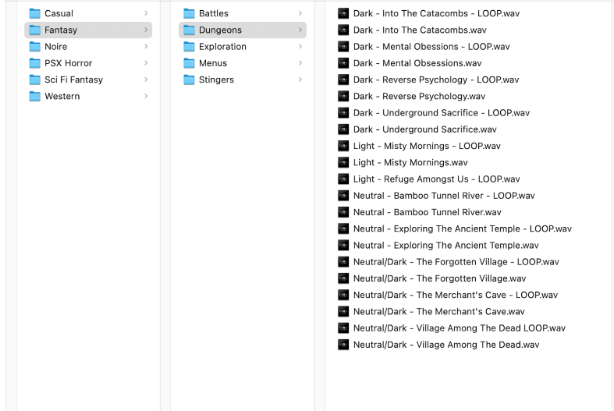
Image: For my fantasy music pack, I included different adjectives to describe the emotion conveyed for dungeon exploration tracks.
What makes these tracks unique / how are they written?
Exploration tracks are usually less melodic than menu/theme tracks. Think of being a part of the environment.
Remember, your role is a supporter, not a leader.
Sometimes, less is more.
💡Tip: Put your exploration track up against gameplay similar to the type of game you’re intending it to be used in. Ask yourself, “Does this track support or get in the way of the gameplay? Does it blend well with the environment? Is it effective?” In some instances, not noticing the music can be a good indicator that it’s playing the right role as a supporter to the gameplay.
⚔️ 3. Battle Tracks
Where will they be used?
Battle tracks are intended to be used in… well, battles! Or any similar area of the game where there is heightened drama and intensity. Depending on the genre of the pack I’m writing for, I’ll sometimes call these “action” tracks.
What makes these tracks unique / how are they written?
Let’s first take a look at the tempo. Faster tempos (120BPM-160BPM+) tend to go well with combative gameplay. While there are exceptions, it’s important to remember this is for an asset pack, which means devs are buying this pack with certain expectations (such as the expectation of a battle track having an upbeat and urgent tempo).
An often overlooked element to consider is the emotional drive that the track carries. This is accomplished by essentially every aspect of the track creation process - through composition, orchestration, and production choices. Having said that, it’s okay for some tracks not to have the emotional drive so that there is contrast and a variety of options for devs to choose from.
Like menu tracks, battle tracks don’t need to be creative masterpieces in order to be effective.
Again, sometimes less is more.
💡Tip: Consider giving devs a variety of options to use per battle track. For example, provide them with variations without the drums, or with the drums only.
🎯Bonus Track Type: Stingers
To top it all off and ensure you’re giving game developers a full game’s worth of material, consider adding in a handful of stingers to your pack.
Where will they be used?
Stingers are short, musical instances that indicate the player did something. For example, acquiring an item, completing a quest, dying, etc.
What makes them unique / how are they written?
I tend to make these no longer than a few seconds. For the most part, the shorter the better, because you don’t want it to clash too much with other sound effects and music that may also be playing.
🎯 Conclusion
Creating a game pack is all about giving game devs value. We want them to have a pack that they can use for their entire game, if they’d like. Something that is consistent, cohesive and brings their game’s vision to life. Following this format of creating menu/theme tracks, exploration tracks, battle tracks, and stingers can give them just that.
And who knows, they may be impressed enough that they’ll want to bring you onto their next project as the composer! It’s happened to me before, and I’m sure it will happen to you as you sharpen these skills.
Happy composing and best of luck!
– Jake Lives