How to Output Music like a Pastor Outputs Sermons
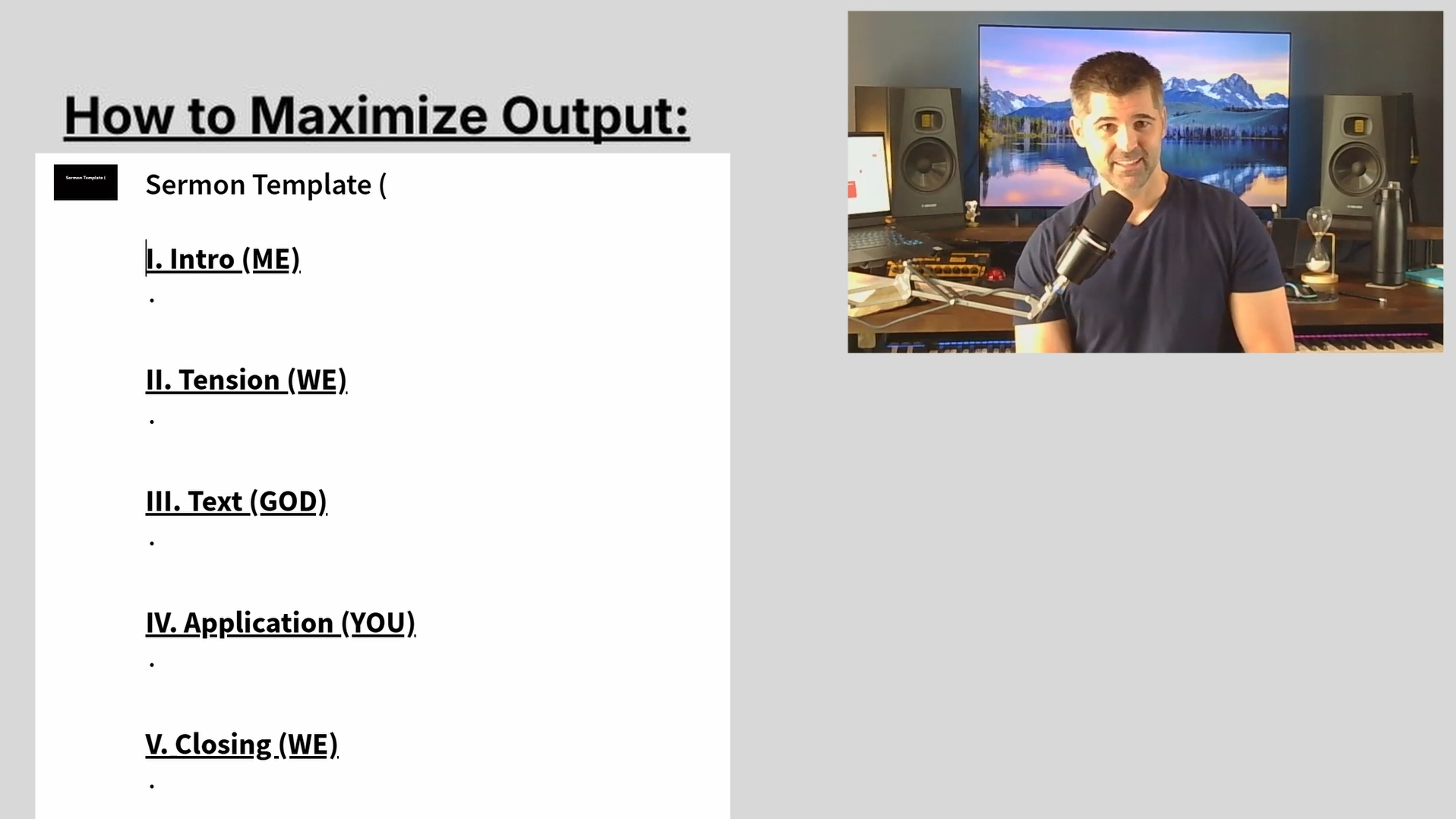
One of the biggest lessons I’ve learned as a composer actually comes from my other career: I’m a full-time pastor.
Over the past five years, I’ve written and preached more than 250 sermons. How? Not because I feel inspired every week.
Simply a matter of time: Sunday comes every seven days.
That simple reality has taught me two things that apply directly to composing: You need a deadline. And you need a system.
⏰ Deadlines Create Momentum
Unlimited time sounds wonderful for creativity, but it can quickly become its enemy.
Without a deadline, we revise endlessly, chase new ideas, start another project, or simply wait for inspiration. Conversely, a stern deadline forces decisions. If you aren’t working for a client yet, give yourself your own deadline.
Try this: One finished cue every week.
That’s roughly 50 tracks in a year and 250 tracks in five years.
Not perfect tracks. Finished tracks. Consistency compounds.
🛠️ Systems Beat the Blank Page
I don’t start every sermon from scratch. I use an established framework that gives me somewhere to begin.
Composers can do the same thing.
Instead of opening an empty DAW and asking “What should I write?”, establish some parameters first: Genre, Mood, Tempo, Key, Form, Instrument roles.
And then pull heavily from the established form, parameters, and language of music.
In doing this, you haven’t eliminated creativity. You’ve eliminated unnecessary decisions so you can spend your creative energy where it matters.
And you won’t be alone, this is common practice among the most successful from history and today.
🎼 Great Composers Used Systems Too
The idea that great composers simply waited for inspiration doesn’t match how many of them actually worked.
Bach borrowed and transformed existing musical material.
Haydn composed constantly within deadlines and established forms.
Mozart possessed enough fluency in musical form to compose extraordinarily quickly when necessary.
Beethoven’s sketchbooks reveal fragments, revisions, rejected ideas, and relentless development.
Modern composers work similarly. John Williams develops timeless melodies by smarting with small motifs and developing through strong melodic architecture, while Hans Zimmer often demonstrates how simple harmony, ostinati, texture, and patient development can create enormous results.
The lesson? You don’t need to reinvent music. You need to become fluent in it.
Here are a few things to lean into and continue to grow per your own systems.
🗺️ Musical Forms Are Maps
Learn established forms:
Binary • Rounded Binary • Ternary • Rondo • Theme & Variation
These aren’t cages. They’re maps.
They help answer one of the most dangerous questions you can face while staring at your DAW: “What happens next?”
Excitingly, the same applies to melody. Understanding structures such as the sentence and period gives you proven ways to introduce, repeat, develop, and resolve musical ideas.
In short, the sentence form starts with a (typically) 2 measure basic idea, then you do it again with slight variation for the next 2 measures, then you ramp everything up for 2 measures in the continuation, then you land on your cadence (likely I or V).
The period form starts the same with a 2 measure basic idea, then you give a 2 measure contrasting idea to that melodic statement, then you repeat the first idea, and then land the plane with a cadence.
Couldn’t be simpler, yet yields amazing results. Once you learn this, you will notice it everywhere in music. You have been warned.
🎹 Familiar Harmony Is Not the Enemy
Don’t be afraid of common chord progressions. You don’t have to do something “new” every time.
Think of harmony like grammar. Thousands of authors use the same words and sentence structures without writing the same novel.
Rather than new progressions, your originality can come through:
Melody • Rhythm • Orchestration • Texture • Development • Dynamics • Timbre
The goal isn’t to make every ingredient original. It’s to make the combination of your decisions uniquely serve the piece.
🎻 Think Function Before Instrumentation
Before deciding which instruments you need, decide which musical roles need to be filled.
Melody • Bass • Harmony • Rhythm • Countermelody • Texture • Atmosphere • Accents
A twelve-instrument arrangement can feel empty when important functions are missing.
A five-instrument arrangement can feel complete when every element has a purpose.
Function first. Instrumentation second.
🔎 Borrow Structure, Not Music
Just a warning, all of this takes integrity to not cross the line. But if we ever end up stealing material instead of learning from it to make our own, we are just wasting our time and not doing the thing we are here for: to create something beautiful and meaningful ourselves musically.
Reference tracks are incredibly useful.
But rather than copying someone else’s music, study how they solved the problem:
How long is the intro?
When does the melody enter?
When does the harmony change?
When are instruments added?
Where does the energy peak?
How does the cue transition or loop?
Learn and borrow the big ideas, learn the architecture, then build your own house.
🚀 Finish the Music
I truly believe if you 1) impose a stark deadline each week and stick to it and 2) learn to move quickly though established systems and musical forms, your output for your music business will increase greatly.
Now, imagine finishing just one cue every week.
A year from now, you could have 50 new pieces.
Five years from now, more than 250.
Those become portfolio tracks, music packs, experiments, learning experiences, and potential client opportunities.
Clients don’t hire portfolios full of ideas. They hire composers who finish music.
So give yourself deadlines. Use proven systems. Trust established musical language. Bring your own voice to it. And then—most importantly—finish the track.
And then, do it again next week.